
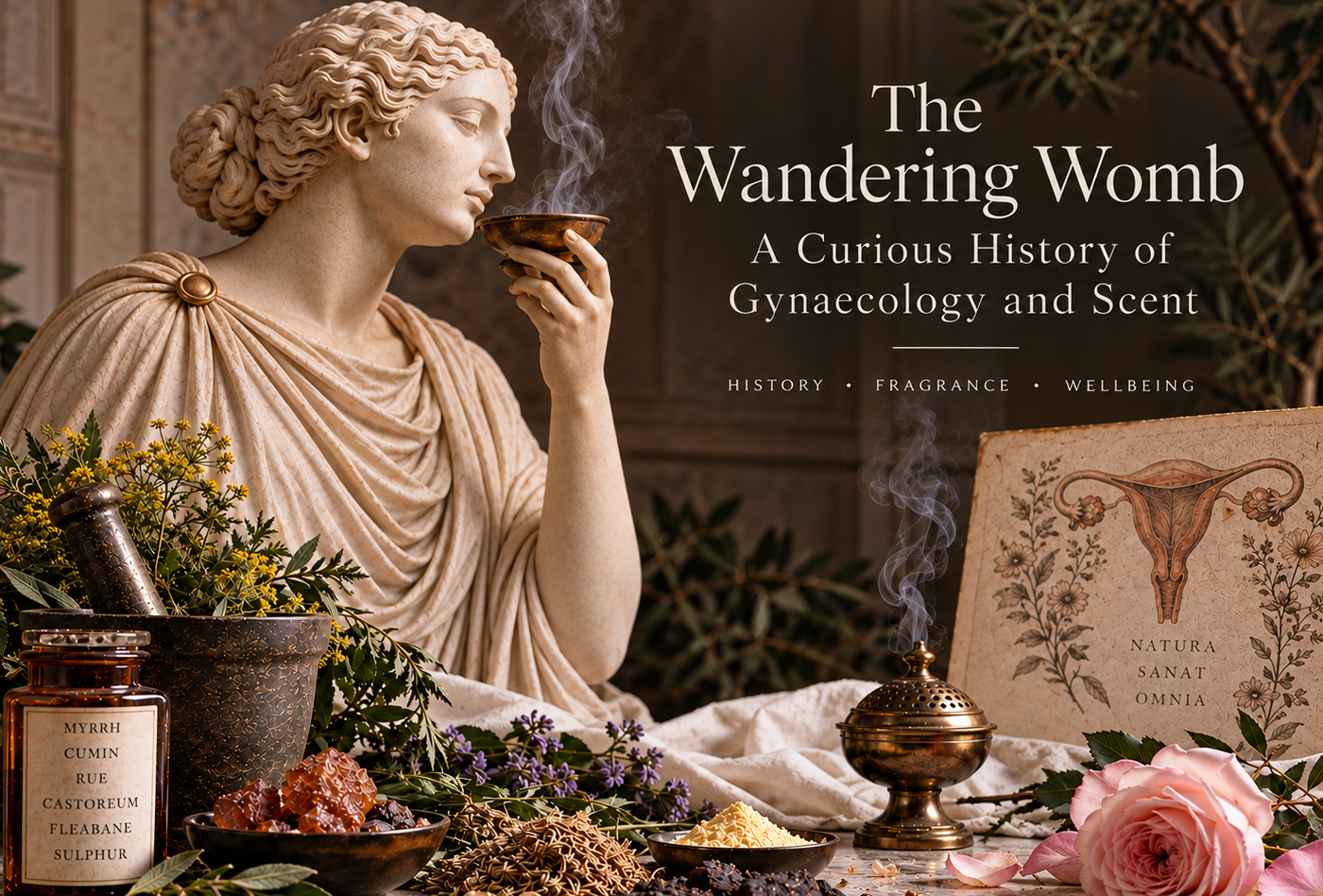
Long before fragrance became something we associated with perfume bottles, beauty counters and personal expression, scent had a rather more unexpected place in medicine.
Among the gynaecological writings of the ancient Greek world was the belief that the womb could sometimes move away from its usual position within the body. In texts belonging to the Hippocratic tradition, this displacement was used to explain a variety of symptoms, including pain, breathlessness, restlessness and episodes of suffocation.
Today, of course, we understand the uterus very differently. It does not wander freely around the abdomen, and the symptoms described in these ancient accounts would not be explained in this way by modern medicine. But rather than dismissing the theory as simply strange, it is perhaps more interesting to consider it for what it was: an attempt to explain genuine human symptoms using the understanding of anatomy and physiology available at the time.
And the proposed treatments reveal something particularly fascinating.
If the womb was thought to have travelled upwards, physicians needed a way to persuade it to return. Their solution involved something Amber & Olive is rather interested in:
Scent.
Attracting the Womb with Scent
The direction of scent mattered. When the womb was believed to have travelled upwards and caused suffocation, one Hippocratic treatment instructed that foul-smelling substances be placed near the nose while sweeter aromas were directed towards the womb. The intention was almost mechanical: repel it from above and attract it from below. When the womb was believed to have moved downwards, the logic could be reversed — pleasant smells above and unpleasant ones below.
Ancient gynaecological texts contain a surprisingly rich collection of aromatic — and decidedly non-aromatic — substances. Myrrh, cumin, rue, castoreum, fleabane and sulphur all appear within treatments described in the Hippocratic writings, although not simply as one mixture used to lure the womb. Some were taken or prepared as remedies, while elsewhere sweet and foul smells were deliberately positioned around the body as part of the treatment for uterine displacement.
To a modern fragrance lover, the ingredients themselves are fascinating.
What Did These Treatments Actually Smell Like?
To a modern fragrance lover, the ingredients are perhaps the most intriguing part of the story. One Hippocratic recipe for uterine suffocation included a drink containing rue, myrrh and Ethiopian cumin, which the historical analysis describes as the more pleasant-smelling ingredients, alongside fleabane, castoreum and brimstone, regarded as the unpleasant side of the mixture. Separately, the same treatment instructed physicians to place foul smells near the nose and sweet smells towards the womb.
Some of those names feel surprisingly familiar today. Myrrh, with its warm, resinous character, still appears in modern perfumery. Cumin is spicy and aromatic, although modern noses may also find it distinctly animalic or bodily. At the other extreme was brimstone — sulphur. Castoreum, an animal-derived material obtained historically from beavers, belonged to the deliberately unpleasant side of this particular ancient preparation.
Other ancient treatments broaden the scent palette even further. Sources describe sweet-smelling vaginal fumigations using materials such as cardamom, cumin, anise, fennel and rose, while foul treatments could involve smoke from burned horn, sulphur or pitch. The contrast was hardly subtle: fragrant, aromatic materials in one direction; smoke, animalic materials and acrid odours in the other.
What is particularly fascinating is that “pleasant” is not necessarily the same thing as “perfume.” Many of these were medicinal, culinary, resinous or intensely aromatic materials. Yet the underlying idea depended on something every perfume wearer still understands instinctively: some smells invite us closer, while others make us pull away.
Perhaps the Womb Was Never the Point
Not everyone in the ancient world accepted the wandering-womb explanation. Centuries after the Hippocratic writings, the physician Soranus of Ephesus rejected the idea that the uterus behaved like a creature that could be tempted by pleasant aromas or frightened away by unpleasant ones. He argued for a physical explanation involving constriction and inflammation instead — an important reminder that ancient medicine was never a single set of unquestioned beliefs.
From a modern perspective, there is no anatomical basis for a womb traveling through the body in pursuit of fragrance. And we should be equally careful not to claim that these aromatic treatments “worked” simply because they were repeatedly described. What remains intriguing, however, is that the womb may not have responded to the scent — but the person experiencing it certainly did.
Today we know that smell is intimately connected with perception, memory, emotion and our experience of the world around us. That doesn’t vindicate the wandering-womb theory, nor does it turn ancient fumigation into modern aromatherapy. It simply leaves us with a surprisingly enduring observation: scent can change an experience, even when it cannot change the anatomy.
Perhaps that is why this strange chapter in gynaecological history feels so at home in a fragrance journal. More than two thousand years later, we no longer try to attract or repel the womb with scent — but we remain fascinated by the extraordinary ability of smell to move us.
Leave a Reply