
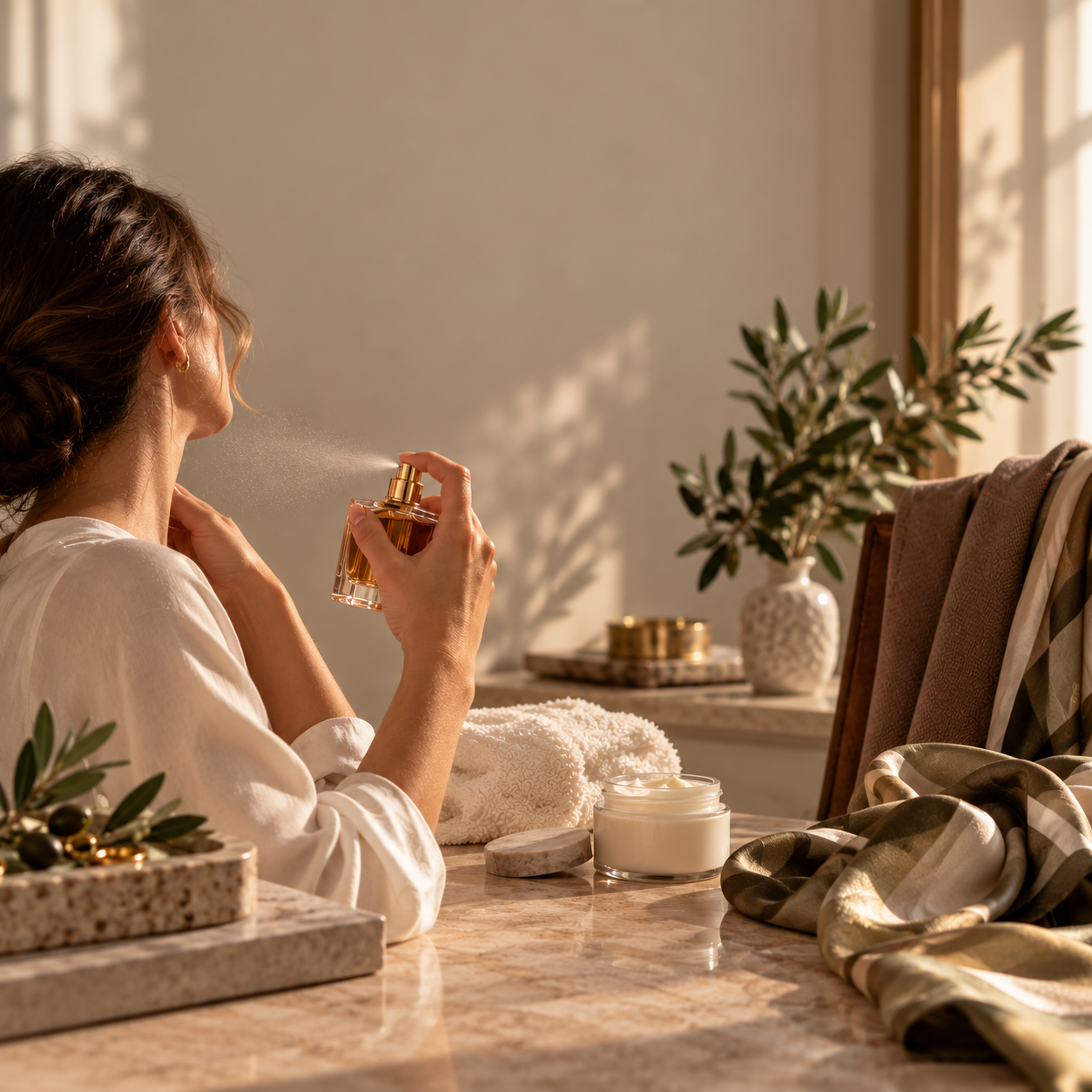
If your perfume seems to disappear after a few hours, the internet has plenty of tricks for you: Vaseline on your pulse points, complicated layering routines, spraying particular parts of the body and countless other “hacks”.
We think finding out how your perfume actually performs is far more useful.
Fragrance behaves differently on skin, clothes and even from one person to another. Heat, humidity, the condition of your skin, where you spray and the fragrance itself can all influence what you experience.
And there is another problem: not being able to smell your perfume doesn’t necessarily mean it has disappeared.Sometimes the projection has simply reduced. Sometimes you’ve become accustomed to the smell around you. And sometimes, yes, the fragrance genuinely doesn’t last very long.
Our approach is simple: start clean, keep your skin moisturised, apply your fragrance where it works for you, test it properly and learn how that particular perfume behaves over a full day.
Forget trying to turn every perfume into a 12-hour beast. Learn how to get the best out of the fragrance you actually bought.
Step 1 — Start With Clean, Moisturised Skin
Before worrying about where to spray, start with the surface you’re spraying onto.
We prefer applying fragrance after a shower, when we’re clean and fresh, rather than trying to mask sweat or another scent that’s already sitting on the skin.
Moisturising is useful too. If your skin is particularly dry, fragrance can behave differently than it does on well-moisturised skin. You don’t need a special perfume product or an elaborate routine — your normal moisturiser is enough.
Heat and humidity matter as well. A hot, sweaty day can completely change how a fragrance feels and projects compared with wearing exactly the same perfume in cool weather.
That’s why performance numbers should never be treated as guarantees. When we say a fragrance lasted eight hours in one of our reviews, we’re describing our experience under those conditions, not promising that everyone will get exactly eight hours.
Good fragrance performance starts with good conditions — not a longevity hack.
Step 2 — Spray Where the Fragrance Can Work
here isn’t one perfect diagram showing exactly where everyone should spray perfume.
For us, the upper body works particularly well: the chest, sides of the neck, behind the ears, shoulders and the back of the neck.
The chest keeps some of the fragrance closer to you, while the neck, shoulders and back of the neck can help create that scent trail you notice when someone moves past you.
Hair can be another interesting place for scent, particularly because movement can help you catch the fragrance throughout the day. We prefer a light touch rather than repeatedly soaking the hair with ordinary alcohol-based perfume.
But don’t become obsessed with finding the “correct” pulse point.
Where you spray should serve how you want to experience the fragrance — both for yourself and in the space around you.
Step 3 — Use Your Clothes to Extend the Experience
If we want a fragrance to stay with us for longer, we don’t rely on skin alone.
Clothes can hold fragrance remarkably well. A perfume that becomes difficult to detect on skin after several hours may still be clearly noticeable on a shirt, jacket or scarf much later — sometimes even the following day.
We don’t have a complicated technique for this. Spray your clothes where it makes sense for what you’re wearing and how you want the fragrance to surround you.
Just use some common sense. Darker fragrance liquids can potentially mark pale or delicate fabrics, so be more cautious with anything expensive or difficult to clean and test an inconspicuous area if you’re unsure.
One of our favourite tests is actually very simple: smell the scarf or clothing again the next morning. The fragrance left behind can reveal a drydown you barely noticed while wearing it.
Skin tells you how a fragrance develops on you. Fabric can show you just how long its character survives.
Step 4 — More Sprays Aren’t Always the Answer
When a perfume doesn’t seem to last, the obvious response is to spray more. But more fragrance doesn’t automatically mean more longevity.
The amount we use depends entirely on the perfume and the day.
For an everyday fragrance, we usually prefer the smallest number of sprays that gives us enough presence. For a special occasion, we may increase it. And sometimes there doesn’t need to be an occasion at all — you simply want to smell good and enjoy your fragrance more.
A powerful perfume may need very little. A lighter fragrance might comfortably take more. Weather, setting and the people around you should all influence that decision.
The goal isn’t to find a magic number of sprays.
Learn the perfume, then adjust the amount to the day you’re actually having.
Step 5 — Learn the Difference Between Longevity and Projection
One of the easiest mistakes to make is assuming that because you can no longer smell your fragrance strongly, it has stopped performing.
Longevity and projection aren’t the same thing.
A fragrance might project strongly for the first couple of hours and then settle into a much smaller scent bubble while remaining on your skin for many hours afterwards.
There’s also your own nose to consider. After being surrounded by the same smell for hours, you may simply notice it less — while somebody walking into the room can still smell it perfectly well.
This is where experience becomes useful. Once you’ve worn a perfume several times and understand its normal performance, learn to trust the fragrance rather than constantly adding more because you’ve temporarily stopped noticing it.
But perfume is also there for you to enjoy. If you want to experience that beautiful opening again later in the day, there’s nothing wrong with a small reapplication.
Sometimes you’re not reapplying because the perfume has failed. You’re reapplying because you want to smell it again.
Step 6 — Test on Skin, Then Live With It
A paper strip is useful for discovering a fragrance, but we would never judge a perfume properly from paper alone.
Put it on your skin and give it time. Then try it again on another day. The opening you loved in the shop is only a few minutes of a fragrance you may wear for eight hours.
We also like testing on clothes and scarves. Don’t just smell them that evening — come back the following morning. Sometimes the scent left on a scarf the next day reveals a beautiful part of the fragrance you barely noticed while wearing it.
This matters when you’re deciding whether a perfume has good longevity, but it matters even more when you’re considering buying it.
Don’t ask how long a perfume lasts after one spray in a shop. Wear it, revisit it and see how it grows on you.
Step 7 — Forget the Hacks
Perfume doesn’t need to become complicated.
There will always be another trick promising to make your fragrance last all day: Vaseline on pulse points, elaborate layering routines, unusual spraying techniques and countless social-media “secrets”.
We don’t build our fragrance routine around hacks.
Start clean. Keep your skin normally moisturised. Spray enough for the fragrance and occasion. Use your clothes when appropriate. Then learn how that particular perfume actually behaves.
Most importantly, accept that fragrances are different. Some will comfortably stay with you from morning until night. Others simply won’t — and that’s not necessarily a flaw.
A beautiful four-hour fragrance doesn’t need to become a twelve-hour fragrance to be worth wearing. If you love it, carry a small decant and enjoy another spray later.
The best longevity trick is knowing your perfume well enough to stop needing tricks.
The Amber & Olive Approach to Fragrance Longevity
Making perfume last longer isn’t about forcing every fragrance to perform the same way.
It’s about understanding what you’re wearing.
Start fresh, keep your skin moisturised, experiment with where you spray, use clothing when appropriate and adjust the number of sprays to the fragrance and the day.
Then pay attention. How long does it project? When does it move closer to the skin? What remains on your clothes the next morning? Do other people still notice it after you’ve stopped noticing it yourself?
After a few proper wears, you’ll know far more about your perfume than any longevity hack can teach you.
And if you love a fragrance that only lasts a few hours? Take a decant, spray it again and enjoy it.
Perfume is supposed to be a pleasure, not a performance test.
Leave a Reply